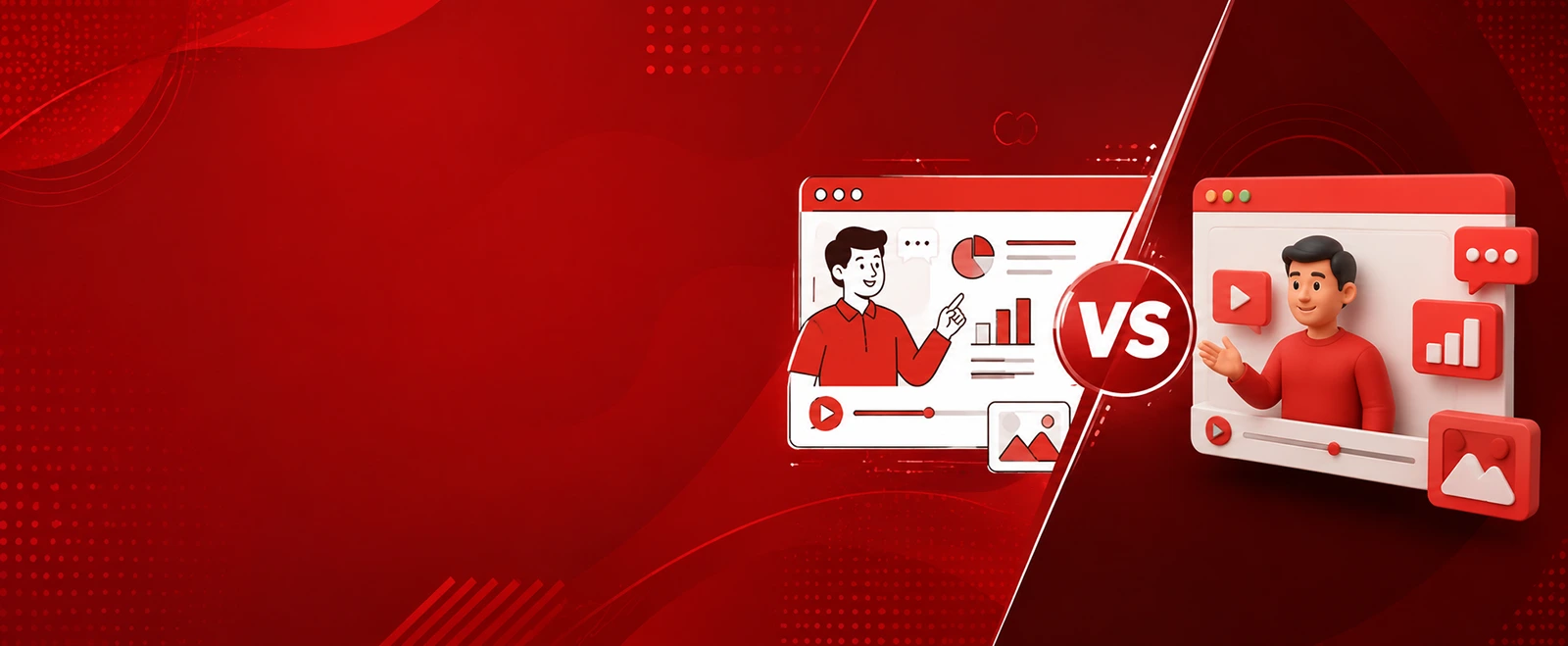

Understanding the difference between 2D and 3D explainer videos is one of the most important decisions a brand can make before investing in video marketing. The style you choose affects everything from production cost and timeline to audience perception and conversion rates.
At Video Jeeves, we have produced thousands of explainer videos across both 2D and 3D formats for startups, SaaS platforms, and enterprise brands. Through that hands-on experience, we have developed a clear perspective on when each style works best and why. This guide breaks down both animation approaches in detail so you can make the right call.
What This 2D vs 3D Animation Guide Covers
This blog gives you a complete side-by-side comparison of 2D and 3D explainer videos, along with practical guidance for choosing the right format. Here is what you will walk away with.
- A clear breakdown of the difference between 2D and 3D explainer videos
- When to choose 2D animation and when to choose 3D
- How each style performs for startups versus established brands
- Budget, timeline, and production complexity comparisons
- Strategic advice on choosing 2D or 3D animation for marketing campaigns
Why the Choice Between 2D and 3D Matters More Than You Think
Choosing between 2D and 3D is not just an aesthetic decision. It has a direct impact on how your audience perceives your brand, how quickly you can launch your video, and how much you will invest in production.
A flat, colorful 2D explainer sends a very different signal than a cinematic, textured 3D product showcase. Neither is universally better. The right choice depends entirely on what you are selling, who you are selling to, and what kind of emotional response you want to trigger.
We have seen brands make costly mistakes by choosing a format based purely on visual appeal rather than strategic fit. That is why understanding the difference between 2D and 3D explainer videos at a strategic level matters far more than simply picking the style that looks more impressive on the surface.
What Is 2D Animation and How Does It Work
2D animation creates movement along two axes, height and width. Characters, objects, and environments are flat and stylized, moving across the screen in a way that feels clean, approachable, and easy to follow.
How 2D Production Works
The typical 2D production process includes:
- Scriptwriting and storyboarding the narrative.
- Character and environment design using vector illustrations.
- Frame-by-frame animation or rigging to create movement.
- Voiceover, sound design, and final compositing to bring everything together.
We have found that 2D animation consistently delivers strong results for brands that need to communicate abstract or service-based concepts quickly and clearly. It has been the foundation of explainer video marketing for over a decade because it balances visual clarity with production efficiency.
Brands looking for professional results in this format can explore a dedicated 2D animation video service built specifically for marketing and brand storytelling.
What Is 3D Animation and How Does It Work
3D animation adds a third axis, depth, to the equation. Objects and characters are modeled in three-dimensional space, textured with realistic materials, lit with virtual lighting setups, and rendered frame by frame to create lifelike or stylized visuals with volume and weight.
How 3D Production Works
The typical 3D production process includes:
- Concept development and storyboarding to establish the visual direction.
- 3D modeling to build characters, products, or environments in digital space.
- Texturing, rigging, and lighting to add surface detail and movement capability.
- Animation, rendering, and compositing to produce the final polished output.
In our experience working with hardware brands and product companies, 3D animation naturally carries a premium, high-tech feel that works incredibly well for product showcases and immersive brand experiences.
Companies that want to leverage this cinematic depth can consider a professional 3D animation video production service to bring physical products and complex systems to life with realism and impact.
When to Choose 2D Explainer Videos
2D animation is the go-to format for a range of business and marketing use cases. It is especially effective when your goal is to explain, educate, or simplify.
Ideal Use Cases for 2D
- SaaS and software explainers where the product is digital and interface-driven.
- Service overviews that need to communicate value quickly.
- Onboarding and training content that prioritizes clarity over spectacle.
- Social media ads where fast production and easy iteration matter.
- Brand storytelling that relies on narrative and character-driven emotion.
Why 2D Works for These Scenarios
2D animation strips away visual complexity and keeps the viewer’s attention locked on the message. When explaining an abstract concept like cloud computing, workflow automation, or data analytics, flat stylized visuals prevent cognitive overload and guide the viewer through the story step by step.
We consistently recommend 2D to early-stage companies for exactly this reason. This is why 2D dominates the conversation around 2D vs 3D explainer videos for startups. Early-stage companies need to communicate value fast, and 2D delivers that clarity without requiring a massive production budget.
When to Choose 3D Explainer Videos
3D animation shines when you need to showcase something tangible, physical, or technologically advanced. It adds weight, dimension, and a cinematic quality that instantly elevates brand perception.
Ideal Use Cases for 3D
- Physical product demos where viewers need to see the object from every angle.
- Engineering and manufacturing visualizations that require technical precision.
- Medical and pharmaceutical explainers that demand anatomical accuracy.
- Architecture and real estate walkthroughs that simulate real spaces.
- Premium brand campaigns where a high-end visual identity is essential.
Why 3D Works for These Scenarios
When a product exists in the physical world, 2D can only go so far in communicating its value. A 3D explainer video lets viewers rotate, zoom into, and explore a product as if they were holding it. That level of immersion builds trust and desire in ways that flat graphics simply cannot replicate.
We have seen this play out repeatedly with hardware and medtech clients where 3D became not just a creative preference but a strategic necessity. For brands in hardware, manufacturing, healthcare, or luxury markets, 3D is often the only format that does the product justice.
Side-by-Side Comparison of 2D and 3D Explainer Videos
Factor |
2D Animation |
3D Animation |
|
Visual Style |
Flat, colorful, stylized |
Dimensional, textured, realistic |
|
Best For |
Software, SaaS, services, education |
Physical products, engineering, premium brands |
|
Production Timeline |
Faster, typically 3 to 6 weeks |
Longer, typically 6 to 12 weeks |
|
Budget Range |
More affordable for most businesses |
Higher due to modeling and rendering |
|
Brand Perception |
Approachable, friendly, modern |
Innovative, sophisticated, high-end |
|
Cross-Platform Versatility |
Highly adaptable across all formats |
May require reformatting for some channels |
|
Revision Flexibility |
Easier and faster to revise |
More complex and time-intensive to adjust |
|
Emotional Tone |
Educational, warm, narrative-driven |
Cinematic, immersive, awe-inspiring |
This table highlights the core difference between 2D and 3D explainer videos across the factors that matter most when making a production decision.
2D vs 3D Explainer Videos for Startups
Startups face unique constraints that make this decision especially important. Limited budgets, tight launch timelines, and the need to validate product market fit quickly all influence which animation style makes the most sense.
Why Most Startups Start with 2D
For the majority of early-stage companies, 2D animation is the smarter first investment. Here is why.
- Budget efficiency allows startups to produce high-quality videos without overextending.
- Faster turnaround means the video can launch alongside the product or funding campaign.
- Easy iteration makes it simple to update messaging as the product evolves.
- Platform flexibility ensures the video performs well on landing pages, pitch decks, social media, and investor presentations.
When evaluating 2D vs 3D explainer videos for startups, the deciding factor usually comes down to whether the product is digital or physical. A SaaS dashboard does not need 3D depth. A smart home device absolutely does. We have guided dozens of startup founders through this exact decision, and the pattern holds consistently.
When Startups Should Consider 3D
Hardware startups, medtech companies, and consumer electronics brands often benefit from 3D even at an early stage. If a product’s physical design is a core selling point, investing in 3D animation can create a perception of quality and innovation that accelerates trust and funding. A detailed breakdown of the top reasons to hire an explainer video production company can also help founders make more informed choices.
Choosing 2D or 3D Animation for Marketing Campaigns
Marketing teams often approach this decision differently from product teams. The question shifts from “what represents the product best” to “what will perform best across channels and audiences.”
Channel Considerations
- Landing pages and websites perform well with both formats, depending on the product.
- Social media ads often favor 2D because of faster production cycles and easier A/B testing.
- Trade shows and presentations benefit from 3D because of the visual impact on large screens.
- Email campaigns lean toward 2D for lighter file sizes and faster load times.
Audience Considerations
Understanding your audience is critical when choosing 2D or 3D animation for marketing. A B2B audience evaluating enterprise software will respond well to clean, focused 2D animation that respects their time. A consumer audience browsing Instagram will stop scrolling for a visually stunning 3D product reveal.
We have run campaigns across both formats, and the performance data consistently reflects these audience preferences. Matching format to audience is one of the highest-leverage decisions in video marketing.
Campaign Goal Considerations
If the goal is education and conversion, 2D typically outperforms because it keeps the message front and center. If the goal is brand awareness and emotional impact, 3D creates the kind of visual spectacle that earns shares, saves, and organic reach.
The key takeaway is that choosing 2D or 3D animation for marketing is not about personal taste. It is about aligning the format with the channel, the audience, and the desired outcome.
Combine 2D and 3D in One Video
Many brands today use hybrid animation that blends 2D motion graphics with 3D product renders. This approach gives you the storytelling flexibility of 2D with the visual depth of 3D.
For example, a video might use 2D animated characters and icons to explain a problem and then transition into a 3D product render to showcase the solution. We have produced several hybrid videos for clients who wanted narrative clarity without sacrificing product realism, and the results have been consistently strong.
Understanding the difference between 2D and 3D explainer videos also means knowing when to blend them strategically rather than choosing one exclusively. Brands interested in exploring how different animation styles compare can find valuable context for making hybrid production decisions.
Common Mistakes When Choosing Between 2D and 3D
Even with a clear understanding of both formats, brands sometimes make avoidable mistakes during the decision process. We have seen these patterns come up repeatedly across client conversations.
Choosing 3D Just for the Wow Factor
3D looks impressive, but if the product is a digital service or abstract concept, forcing it into a 3D format can actually create confusion instead of clarity. The visual complexity can overshadow the message.
Defaulting to 2D Without Considering the Product
On the other hand, some brands default to 2D because it is faster and cheaper without considering whether their product genuinely needs dimensional representation. A physical product shown in a flat 2D can feel underwhelming and fail to communicate quality.
Ignoring the Target Audience
A playful 2D explainer might resonate with a startup founder but fall flat with a C-suite executive evaluating enterprise solutions. Similarly, a cinematic 3D video might feel excessive for a casual mobile app audience.
Underestimating Revision Complexity
3D revisions take significantly longer than 2D adjustments. If a brand is in a phase where messaging changes frequently, starting with 2D gives far more flexibility to iterate without burning through budget. Brands seeking polished visuals with faster turnaround can also explore motion graphics video service as a versatile middle ground that blends design precision with production speed.
Frequently Asked Questions
Finding the Right Animation Style for Your Brand Story
There is no universal winner when it comes to the difference between 2D and 3D explainer videos. The right choice always comes down to your product, your audience, and your marketing goals. What matters most is that the animation style you choose serves the message rather than competing with it.
If you are ready to explore which format fits your brand best, Video Jeeves brings deep experience across both 2D and 3D production to help you make that decision with confidence. The right explainer video does not just look great. It drives the signups, demos, and conversions your brand is building toward.